Understanding Building Automation in HVAC Controls
Commercial HVAC Control Systems: Advanced Solutions for Energy Efficiency and Building Automation
Commercial HVAC control systems are the coordinated networks of sensors, controllers, actuators, user interfaces, and software that automate temperature, ventilation, humidity, and energy use across large facilities. These systems work by collecting real-time telemetry from field devices, executing control logic on controllers (DDC, PLCs, or cloud services), and adjusting actuators to maintain schedules, setpoints, and indoor air quality goals while minimizing energy consumption. Facility managers and engineers benefit from improved occupant comfort, measurable energy savings, and reduced unplanned downtime when controls are properly specified and commissioned. This article explains how commercial HVAC control systems function, the measurable benefits they deliver, and the technologies driving recent advances in building automation. You’ll find practical comparisons of DDC, BAS, and EMS solutions, facility-specific tailoring for hospitals, schools, industrial sites, and offices, and clear steps facility managers can take to plan, budget, and secure a quote. Along the way, we note how CCS Mechanical Inc.’s engineering-driven, in-house fabrication approach supports reliable implementations and career opportunities for HVAC technicians and controls engineers.
What Are Commercial HVAC Control Systems and How Do They Work?
Commercial HVAC control systems are integrated architectures that sense environmental conditions and automatically regulate HVAC equipment to meet performance, comfort, and efficiency objectives. They operate by closing control loops: sensors measure variables like temperature and CO₂, controllers compute corrective outputs, and actuators modulate valves or dampers to reach setpoints. The result is continuous optimization—schedules, demand responses, and fault detection reduce energy use while preserving required indoor air quality. Modern systems layer supervisory software that aggregates data for visualization, analytics, and alarms, providing both local control and remote management capabilities. Understanding these mechanisms clarifies why control strategy and commissioning are as important as hardware selection for lasting savings and reliability.
What Is the Role of Building Automation Systems in Commercial HVAC?
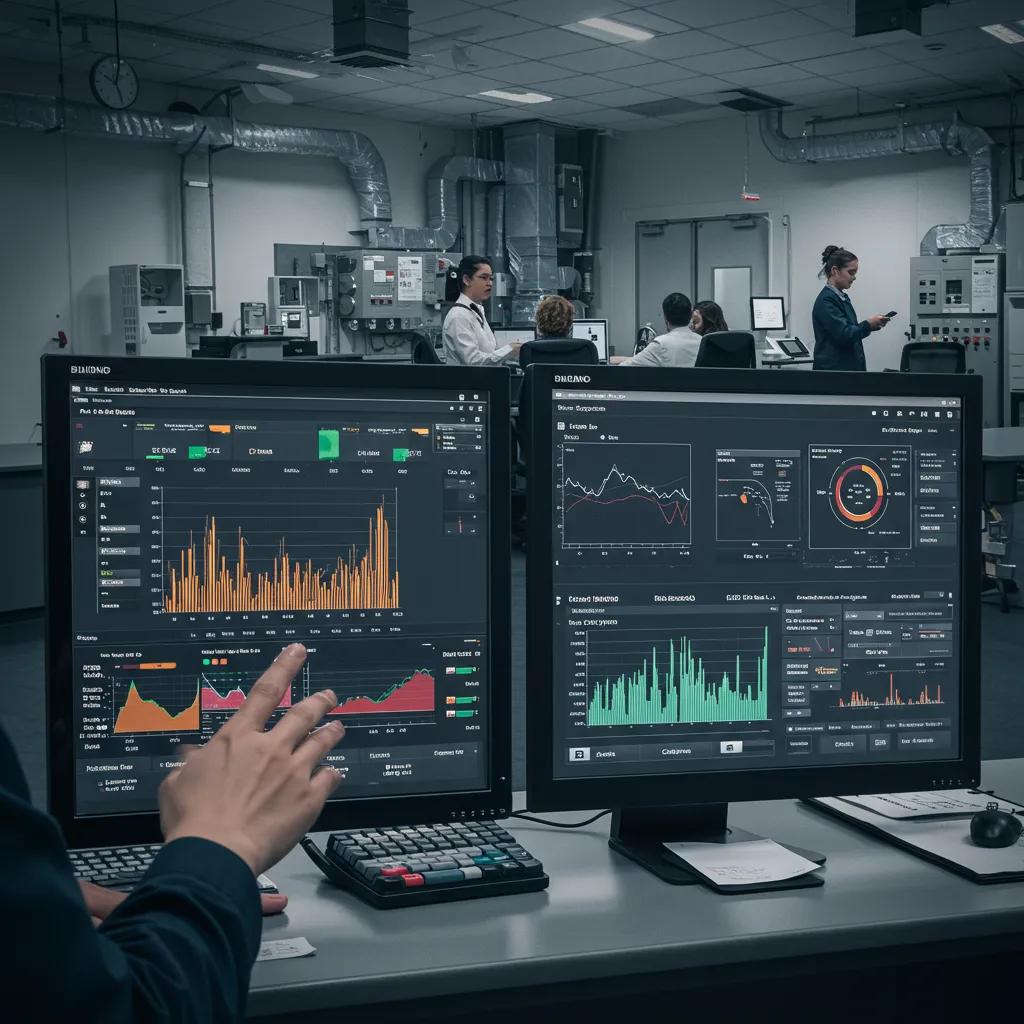
Building Automation Systems (BAS) serve as the centralized orchestration layer that integrates HVAC with lighting, access, and other building services to coordinate performance and reporting. A BAS typically hosts the system database, scheduling engine, trending, alarm management, and user interfaces used by operators to manage multi-zone facilities. By unifying disparate equipment through common protocols like BACnet or Modbus and implementing coordinated sequences of operation, BAS enables energy-saving strategies such as night setbacks, integrated HVAC/ventilation control, and demand response participation. Effective BAS deployment requires careful interoperability planning and verified sequences to ensure that automation delivers predictable operational and energy outcomes.
How Do Direct Digital Controls Enhance HVAC Performance?
Direct Digital Controls (DDC) replace legacy pneumatic or electromechanical controllers with microprocessor-based controllers that execute precise control algorithms, log historical data, and enable remote setpoint adjustments. DDC controllers improve temperature and humidity stability through faster sampling and finer output modulation, reducing overshoot and energy waste. Data logging from DDC enables trend analysis and tuning of control loops, which improves performance over time and supports predictive maintenance workflows. In retrofit scenarios, DDC upgrades often yield rapid improvements in control fidelity and measurable energy savings when coupled with proper commissioning and tuning.
What Components Make Up a Modern Commercial HVAC Control System?
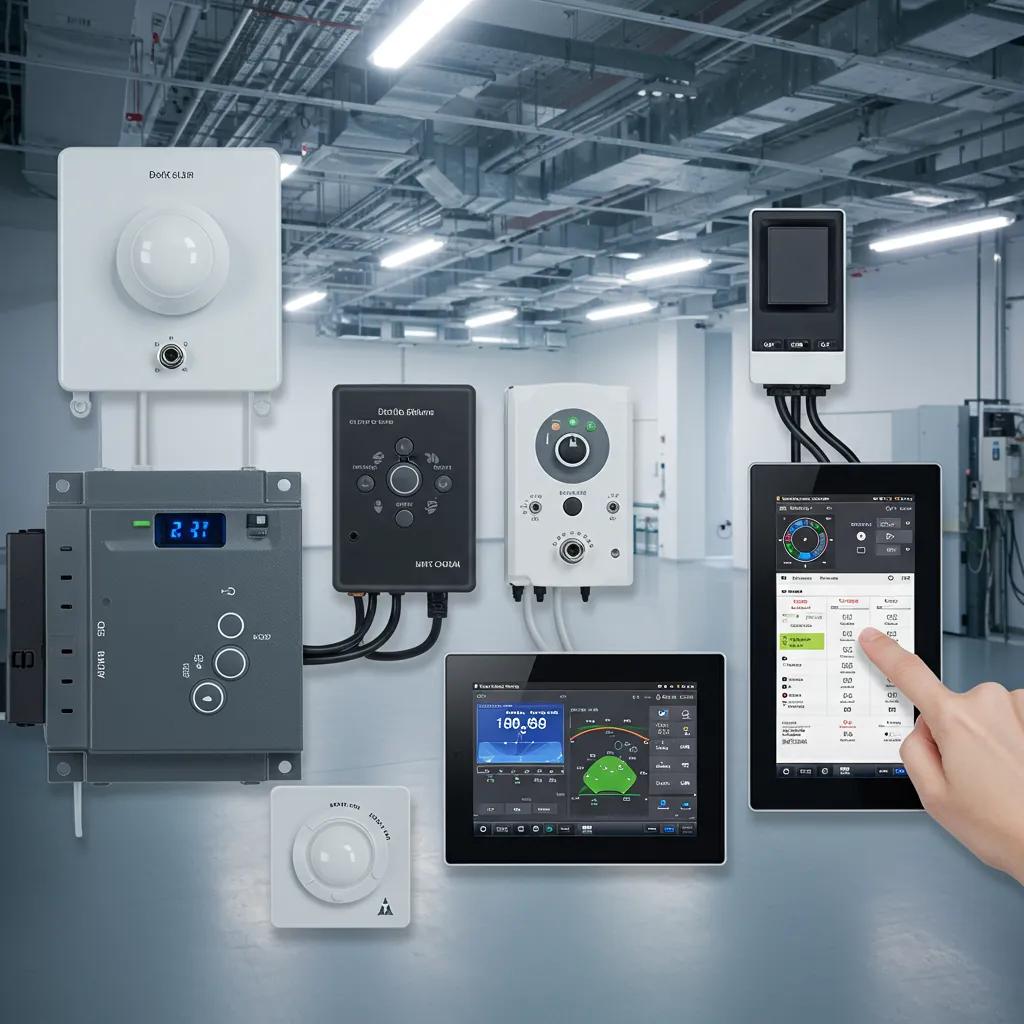
A modern commercial HVAC control system consists of a networked set of sensors (temperature, humidity, CO₂, pressure), field controllers (DDC, PLCs), actuators (modulating valves, dampers), control panels and HMIs, and supervisory software or cloud platforms for analytics. Sensors provide the essential data that feeds control logic; controllers interpret that data and execute algorithms; actuators implement physical changes to the HVAC plant; and the supervisory layer aggregates telemetry for reporting and alarms. Communications protocols and cybersecurity layers ensure reliable, secure data flow between these components, while carefully engineered control sequences determine how equipment responds to changing conditions.
What Are the Key Benefits of Commercial HVAC Control Systems for Businesses?
Commercial HVAC control systems deliver four core benefits that directly impact operating cost, occupant health, uptime, and staffing efficiency across facilities. First, control strategies reduce energy consumption and demand charges through scheduling, optimized setpoints, and economizer logic. Second, IAQ improvements from sensor-driven ventilation and humidity control support occupant comfort and regulatory compliance. Third, predictive maintenance enabled by continuous telemetry reduces emergency repairs and asset downtime. Fourth, centralized automation simplifies operations and reduces manual monitoring and dispatch. These outcomes together create tangible ROI pathways for capital investment in controls and often make projects eligible for efficiency incentives and utility rebates.
Here are the primary business benefits:
- Energy Reduction: Automated scheduling and optimized setpoints lower overall HVAC energy use.
- Improved Indoor Air Quality: Sensor-driven ventilation keeps CO₂ and humidity within target ranges.
- Lower Maintenance Costs: Predictive alerts reduce emergency repairs and extend equipment life.
- Operational Efficiency: Centralized alarms and dashboards streamline facility staff workflows.
These benefits typically compound: energy savings free budget for reinvestment while improved IAQ and uptime support occupant productivity and compliance. The next subsection examines energy strategies in greater detail.
How Do HVAC Controls Improve Energy Efficiency in Commercial Buildings?
HVAC controls improve energy efficiency by implementing strategies such as occupancy-based scheduling, setpoint optimization, use of economizers, and coordinated plant staging for chillers and boilers. These strategies reduce runtime for major equipment, curtail simultaneous heating/cooling conflicts, and enable peak-shaving during demand events, delivering typical savings ranges when properly commissioned. Modern EMS dashboards quantify consumption trends and isolate high-usage zones for targeted measures; combining these dashboards with value engineering often accelerates payback. Facility managers should prioritize measurement and verification—baseline metering plus trend analysis—to capture the realized savings and qualify for incentives.
Energy-saving control strategies include:
- Occupancy Scheduling: Aligns HVAC runtime to actual building use to reduce unnecessary heating or cooling.
- Optimal Start/Stop: Prepares spaces to reach comfort setpoints only when needed.
- Plant Staging and Reset: Matches chiller/boiler operation to load to improve part-load efficiency.
These strategies are interdependent and perform best when verified through trending and periodic tuning.
The table below maps common control approaches to their mechanisms and expected impacts, supporting budgeting and ROI conversations.
This mapping helps prioritize control investments based on building use and expected returns. Next, we explore how controls maintain indoor air quality while balancing energy goals.
In What Ways Do Control Systems Enhance Indoor Air Quality?
Control systems enhance IAQ by using CO₂, VOC, particulate, and humidity sensors to modulate ventilation and filtration dynamically, instead of relying on fixed ventilation schedules. Demand-controlled ventilation adds fresh air when occupancy increases and reduces it during low occupancy, preserving energy while maintaining acceptable CO₂ concentrations. Humidity control prevents mold growth and supports sensitive processes in healthcare or manufacturing; differential pressure control protects specialty areas. Combining sensor-driven ventilation with filtration management and scheduled purge cycles enables facilities to meet IAQ targets and regulatory requirements efficiently.
Multi-Agent Systems for Energy-Efficient HVAC Control
The growing demand for energy-efficient and resilient infrastructure, particularly in large-scale facilities such as data centers, necessitates innovative control strategies. This study proposes a distributed control architecture based on multi-agent systems (MAS) for air-cooled chiller systems. The framework integrates localized decision-making with coordinated optimization to enhance system-wide efficiency, scalability, and security. Unlike traditional centralized approaches, the proposed architecture employs autonomous agents for real-time monitoring, adaptation, and fault tolerance, while also meeting stringent security requirements. Experimental results demonstrate improvements of 5 to 20% in energy efficiency, 30 to 40% faster anomaly detection, and up to 30% enhancement in predictive maintenance scheduling. Compared to centralized and cloud-based methods, the proposed MAS framework offers superior adaptability, fault resilience, and cybersecurity. Future research directions include integrating hybrid AI models, generative pipelines for adaptive learning, and interoperability with emerging smart grid technologies.
Multi-agent Architecture in Distributed Environment Control Systems: Vision, Challenges, and Opportunities, N Astudillo, 2025
Which Types of Commercial HVAC Control Systems Does CCS Mechanical Provide?
Commercial HVAC control work spans several system types—Direct Digital Controls (DDC), Building Automation Systems (BAS), Energy Management Systems (EMS), and smart sensors/actuators—and CCS Mechanical deploys and integrates these solutions for commercial and industrial clients. Each system type serves specific goals: DDC for precise local control, BAS for centralized orchestration across systems, EMS for energy-focused dashboards and demand response, and smart field devices for improved telemetry fidelity. When a project requires custom control panels or prefabricated assemblies, CCS Mechanical leverages in-house fabrication and CAD capabilities to streamline implementation. For HVAC technicians and controls engineers, CCS Mechanical offers hands-on opportunities to work with BAS/DDC/EMS technologies and field commissioning; facility managers can request a consultation or quote to see how these system types match their operational priorities.
What Are Direct Digital Controls and Their Applications?
Direct Digital Controls (DDC) are microprocessor-based controllers that execute control logic for air handling units, VAV boxes, chillers, and pumps, enabling precise setpoint control and data logging for each control loop. DDC deployments are common on AHUs for temperature and humidity control, VAV terminals for zone regulation, and chiller plant sequencing for plant efficiency. When migrating from older pneumatic systems, DDC upgrades improve loop stability, reduce maintenance overhead, and allow centralized supervision. For retrofit projects, planning for sensor upgrades, loop tuning, and commissioning ensures expected performance gains.
How Does Building Automation System Integration Work?
BAS integration follows a structured workflow: site assessment, design and sequence development, hardware and software selection, programming and protocol mapping, then commissioning and validation. Interoperability planning—ensuring BACnet or Modbus mapping and addressing legacy equipment—avoids data gaps during integration. Commissioning verifies sequences of operation and validates setpoint coordination across systems, while trend logging supports ongoing optimization. This five-step approach reduces risk and delivers reliable outcomes for multi-system facilities.
BAS integration steps:
- Assessment and data collection: Inventory equipment and control points.
- Design and sequencing: Define control logic and interlocks.
- Programming and integration: Implement controllers and network mapping.
- Commissioning and validation: Test sequences and fine-tune.
- Handover and training: Provide operator interfaces and documentation.
These steps ensure that BAS integration meets performance and maintainability objectives.
What Are Energy Management Systems for Commercial HVAC?

Energy Management Systems (EMS) layer analytics and dashboards over BAS/DDC data to track consumption, set alerts, and enable demand response and peak shaving. Typical EMS features include energy dashboards, scheduled reporting, fault detection, and automated demand-limiting strategies that reduce peak charges. EMS quantifies savings by comparing baseline and post-implementation consumption, supporting value engineering and incentive applications. For facility teams, EMS provides clear visualizations that prioritize retrofit candidates and guide operational changes.
The table below contrasts DDC, BAS, and EMS by capabilities, common applications, and typical benefits to help decision-makers choose the right scope.
This comparison highlights the complementary nature of control system types and supports scoping decisions. The next subsection covers field devices that complete system fidelity.
How Do Smart HVAC Sensors and Actuators Enhance System Control?
Smart sensors (temperature, humidity, CO₂, pressure) and modulating actuators (valves, dampers) increase the fidelity of control loops by delivering accurate, timely data and smooth mechanical responses. Improved sensor accuracy reduces control hysteresis and prevents frequent cycling, while responsive actuators allow finer modulation to maintain stable conditions. Retrofit actuator upgrades and wireless smart sensors enable targeted improvements without full-system replacement. These field-device upgrades directly contribute to better IAQ, lower energy use, and clearer diagnostic visibility.
How Are Commercial HVAC Control Systems Tailored for Different Facility Types?
Tailoring control strategies to facility type is essential because priorities and constraints differ: hospitals require redundancy and rigorous IAQ controls, schools prioritize occupant comfort and scheduling, industrial facilities demand process integration and rugged devices, and offices focus on zone comfort and tenant satisfaction. Control architecture choices—centralized BAS, distributed DDC, or hybrid EMS overlays—should reflect those priorities while balancing cost, scalability, and lifecycle maintenance. We typically begin a facility-specific tailoring exercise with stakeholder interviews, followed by prioritized requirements, then a phased implementation plan that aligns controls to measurable KPIs like energy intensity, IAQ metrics, and equipment uptime.
What Control System Solutions Are Best for Hospitals and Healthcare Facilities?
Hospitals require high-availability controls, validated IAQ, and strict zoning with differential pressure control to protect sterile spaces and isolation rooms. Solutions emphasize redundant controllers, validated sequences for HEPA filtration and ventilation, and rigorous commissioning/validation to meet regulatory and clinical requirements. Controls must integrate with building management and clinical workflows to ensure patient safety and uninterrupted operation of critical systems. Documentation and traceability are essential for compliance and ongoing performance verification.
How Do Schools Benefit from Advanced HVAC Controls?
Schools benefit from advanced scheduling, CO₂-based demand-controlled ventilation, and remote management across multiple buildings or classrooms to maintain learning-appropriate comfort while managing energy budgets. Zoned scheduling aligns ventilation and temperature control to occupancy and class timetables, while remote dashboards enable district-level oversight and faster response to issues. These capabilities reduce energy waste during unoccupied periods and improve classroom air quality, which supports student health and concentration.
What Are the Unique HVAC Control Needs of Industrial Facilities?
Industrial facilities often require process-driven temperature and humidity control, integration with process control systems, and ruggedized field devices tolerant of harsh environments. Controls must interoperate with PLCs and process automation systems, prioritize safety interlocks, and provide robust telemetry for emissions monitoring and process compliance. Custom sensor suites and hardened actuators ensure reliable operation in conditions that would challenge standard commercial hardware.
Industrial control priorities include:
- Process integration: Seamless data exchange with PLCs and SCADA.
- Durability: Field devices rated for industrial conditions.
- Safety and compliance: Controls tied to regulatory monitoring and alarms.
These priorities inform hardware selection and controls architecture for industrial sites.
How Do Commercial Office Buildings Optimize HVAC Controls?
Office buildings typically optimize HVAC controls through VAV and zone-based strategies, occupancy-based scheduling, and tenant-focused dashboards that balance comfort with energy goals. VAV optimization reduces fan and reheat energy by matching airflow to actual load, while tenant dashboards provide transparent reporting that aids lease discussions and comfort tuning. Multi-tenant buildings benefit from flexible scheduling and metering that support tenant comfort and billing clarity.
The following table maps facility types to control priorities and typical solutions for quick reference.
This facility mapping helps prioritize control investments and sets expectations for commissioning complexity.
Why Choose CCS Mechanical for Your Commercial HVAC Control System Needs?
CCS Mechanical Inc. is an engineering-driven partner that combines hands-on controls expertise with in-house fabrication and CAD capabilities to deliver reliable, customized control solutions for commercial and industrial clients. Their approach emphasizes detailed engineering during design, prefabricated control panels for faster installs, and commissioning rigor that reduces post-install issues. Local expertise in Florida markets and a service focus aimed at both facility managers and controls professionals makes CCS Mechanical a practical choice for facilities seeking integrated HVAC control upgrades. CCS Mechanical offers HVAC technicians and controls engineers opportunities to work on complex BAS/DDC/EMS projects with direct exposure to fabrication and CAD workflows. Facility managers seeking quotes or consultations can contact CCS Mechanical to initiate site assessments and value-engineered proposals.
How Does CCS Mechanical’s Engineering-Driven Approach Benefit Clients?
An engineering-driven approach ensures sequences of operation are optimized for both performance and reliability, reducing commissioning iterations and operational surprises. Engineers refine control logic, perform load and equipment sequencing analyses, and validate performance through testing and trend verification. This design rigor leads to predictable energy performance, clearer documentation for operations teams, and fewer reactive service calls over the lifecycle of the installation.
What Advantages Does In-House Fabrication Provide for Control Systems?
In-house fabrication and CAD capabilities shorten lead times for custom control panels, allow tighter quality control over wiring and assembly, and reduce coordination risks between vendors. Prefabricated panels can be bench-tested before shipment, which lowers on-site labor, minimizes wiring errors, and expedites commissioning. For projects with critical schedules, these fabrication capabilities directly reduce project duration and improve first-time startup success.
How Does CCS Mechanical Support Energy Efficiency and Sustainability Goals?
CCS Mechanical supports energy efficiency through energy audits, EMS deployment, and value engineering to align upgrades with incentive programs and operational goals. By combining analytics with control strategy implementation, they help quantify savings and identify short- and long-term opportunities for decarbonization. Measured results from EMS dashboards provide the data needed to demonstrate outcomes for sustainability reporting and potential incentive qualification.
What Career Opportunities Exist in HVAC Control Systems at CCS Mechanical?
CCS Mechanical recruits HVAC technicians and controls engineers to work on BAS, DDC, EMS, and field commissioning projects that offer hands-on experience with modern control technologies and in-house fabrication. Typical roles include controls technician, controls programmer, and field commissioning engineer, with mentorship and training opportunities tied to complex projects. Technicians and engineers gain exposure to both hardware assembly and software configuration, which supports career growth in systems integration and building automation disciplines.
How Can Facility Managers Get Started with Commercial HVAC Control Systems?
Facility managers can initiate control projects by following a structured process: request an initial site assessment, gather equipment and operating data, prioritize objectives (energy, IAQ, uptime), and solicit proposals that include measurement and verification plans. Early coordination with operations staff and budgeting for commissioning and post-acceptance tuning ensures the project achieves targeted outcomes. Clear communication of performance KPIs and a phased implementation plan reduces disruption and fosters measurable results.
What Is the Process for Requesting a Quote or Consultation?
Begin by contacting a qualified controls provider to schedule an initial scoping call and site assessment; document equipment inventories and utility data ahead of the visit to accelerate scoping. The provider will deliver a proposal outlining scope, schedule, budget estimate, and a commissioning plan that includes performance verification. Once terms are agreed, you can schedule installation and a commissioning window with stakeholder involvement for acceptance testing. When evaluating vendors, request references for similar facility types and ask for EMS or BAS dashboard demonstrations.
Steps to request a quote:
- Initial contact and scoping: Share facility goals and equipment lists.
- On-site assessment: Collect data for accurate proposals.
- Proposal and schedule: Receive scope, budget, and commissioning plan.
- Approve and schedule: Plan installation and acceptance testing.
These steps clarify expectations and reduce change orders during implementation. Facility managers may request consultation and quotes from CCS Mechanical to begin this process.
How Does CCS Mechanical Ensure Accurate Budgeting and Value Engineering?
Accurate budgeting relies on detailed scoping, CAD-driven panel design, and prefab capabilities that reduce onsite labor uncertainty. CCS Mechanical applies value engineering during design workshops to balance first-cost and lifecycle cost, recommending phased upgrades when full retrofit budgets are constrained. Transparent estimates with documented assumptions help facilities compare scenarios and select options aligned with long-term performance goals.
What Should Facility Managers Know About System Installation and Optimization?
Expect a structured installation timeline that includes staging, equipment tie-ins, controller programming, and a rigorous commissioning phase with loop testing, sequence validation, and performance optimization. Post-install tuning is essential: trend-based adjustments, setpoint refinements, and controller gain tuning ensure the system meets targets under actual operating conditions. A maintenance and optimization plan tied to predictive maintenance alerts preserves performance and extends equipment life.
What Are the Latest Trends and Technologies in Commercial HVAC Control Systems?
Recent trends in commercial HVAC controls emphasize AI-driven predictive maintenance, cloud-based multi-site management, and deeper IoT integration that yields richer telemetry and automated analytics. Predictive analytics uses machine learning models to detect anomalies and estimate remaining useful life for components, enabling targeted interventions and reduced downtime. Cloud platforms allow enterprise-scale visibility and remote operations across campuses, while cybersecurity and data governance have become central considerations. These trends accelerate the shift from reactive to proactive facility management.
How Is AI-Powered Predictive Maintenance Transforming HVAC Controls?
AI-powered predictive maintenance analyzes historical and real-time telemetry—temperatures, vibration, current draw, and runtime—to detect patterns preceding failure and to forecast remaining useful life. This capability converts continuous data into prioritized maintenance work orders and reduces unplanned outages by scheduling interventions before critical failures occur. Implementation requires clean data sources, labeled events, and integration with CMMS workflows to realize operational benefits.
What Role Does Cloud-Based HVAC Management Play in Modern Systems?
Cloud-based HVAC management provides remote dashboards, multi-site coordination, and centralized updates for control logic and analytics, enabling centralized teams to manage performance across distributed portfolios. Advantages include scalable analytics, simplified historical data retention, and rapid deployment of updates; trade-offs involve security, bandwidth, and latency considerations that must be addressed through robust architecture and governance. For multi-site operators, cloud platforms dramatically lower the cost of centralized performance monitoring.
How Are Regulatory Standards Influencing HVAC Control System Design?
Regulatory standards and incentive programs increasingly require control-enabled solutions to meet energy and IAQ targets, driving adoption of EMS and BAS features that support compliance and reporting. Efficiency standards and retrofit incentives encourage investments in controls that deliver measurable savings. As regulations evolve, designers prioritize flexibility to incorporate future standards and to document performance through verifiable metrics.
What Impact Does Sustainability Have on HVAC Control Innovations?
Sustainability priorities push controls innovation toward decarbonization strategies—optimized plant operation, electrification readiness, and data-driven efficiency improvements that reduce emissions and operating costs. Control strategies that manage load shifting, support renewable integration, and provide sustainability reporting metrics enable facilities to align operational performance with corporate sustainability goals. These innovations make controls central to long-term operational cost reduction and environmental commitments.
- Identify objectives: Define energy, IAQ, and uptime goals before specifying controls.
- Prioritize solutions: Match DDC, BAS, EMS, and sensor upgrades to facility priorities.
- Plan commissioning: Budget for commissioning, tuning, and measurement verification.
These practical steps guide managers from strategy to measurable outcomes and support the selection of the appropriate control scope and vendor.
This final table connects recommended actions to outcomes, making the path from planning to verified savings explicit.
Frequently Asked Questions
What factors should facility managers consider when selecting a commercial HVAC control system?
When selecting a commercial HVAC control system, consider factors such as the specific needs of the facility, including energy efficiency goals, indoor air quality requirements, and operational budgets. They should evaluate the compatibility of the system with existing infrastructure, the scalability for future expansions, and the ease of integration with other building management systems. Additionally, assessing the vendor’s support services, warranty options, and the system’s adaptability to regulatory changes is crucial for long-term success.
How can facility managers ensure the successful commissioning of HVAC control systems?
Engage in pre-commissioning activities such as defining performance criteria and establishing a commissioning team. During the commissioning phase, they should conduct comprehensive testing of all control sequences, validate system performance against design specifications, and ensure that all stakeholders are trained on system operation. Post-commissioning, ongoing monitoring and adjustments are essential to maintain optimal performance.
What are the common challenges faced during the implementation of HVAC control systems?
Common challenges during the implementation of HVAC control systems include integration issues with existing equipment, inadequate training for staff, and resistance to change from facility personnel. Additionally, unforeseen technical problems can arise, such as communication failures between devices or software bugs. Budget constraints may also limit the scope of the project, leading to compromises in system capabilities. To mitigate these challenges, thorough planning, stakeholder engagement, and a phased implementation approach are recommended.
How do energy management systems (EMS) differ from building automation systems (BAS)?
Energy Management Systems (EMS) focus primarily on monitoring and optimizing energy consumption, providing analytics, and enabling demand response strategies. They track energy usage patterns and help identify opportunities for savings. In contrast, Building Automation Systems (BAS) integrate various building systems, including HVAC, lighting, and security, to provide centralized control and automation. While both systems can work together, EMS is specifically designed to enhance energy efficiency, whereas BAS offers broader operational control across multiple systems.
What role does predictive maintenance play in HVAC control systems?
Predictive maintenance in HVAC control systems utilizes data analytics and machine learning to forecast equipment failures before they occur. By analyzing historical performance data and real-time telemetry, predictive maintenance identifies patterns that indicate potential issues, allowing facility managers to schedule maintenance proactively. This approach minimizes unplanned downtime, extends equipment lifespan, and reduces overall maintenance costs. Implementing predictive maintenance requires a robust data collection framework and integration with existing maintenance management systems for effective execution.
How can facility managers measure the effectiveness of their HVAC control systems?
Measure the effectiveness of HVAC control systems through key performance indicators (KPIs) such as energy consumption, indoor air quality metrics, and occupant comfort levels. Regular monitoring of system performance data, including temperature, humidity, and CO₂ levels, provides insights into operational efficiency. Additionally, conducting energy audits and comparing pre- and post-implementation data can help quantify savings and validate the return on investment. Feedback from occupants can also serve as a qualitative measure of system effectiveness.
What are the latest innovations in HVAC control technology?
Recent innovations in HVAC control technology include the integration of artificial intelligence for predictive analytics, advanced IoT sensors for real-time monitoring, and cloud-based management platforms for remote access and control. These technologies enhance system responsiveness, improve energy efficiency, and facilitate data-driven decision-making. Additionally, developments in cybersecurity measures are crucial to protect sensitive data and ensure the integrity of HVAC systems. As sustainability becomes a priority, innovations also focus on optimizing energy use and supporting renewable energy integration.